
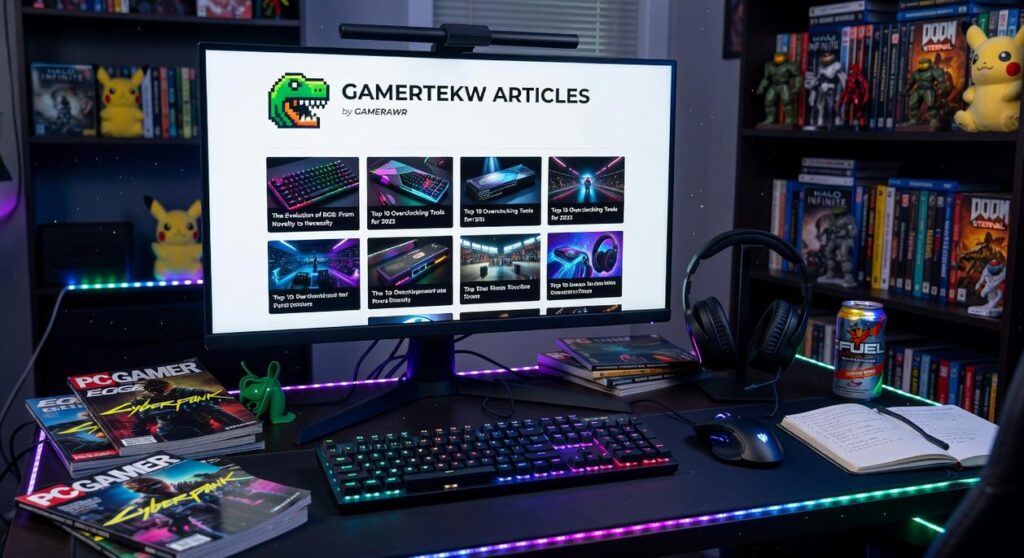
I’ve spent years testing gaming hardware and cutting through the marketing noise that floods this industry.
You’re probably tired of reading spec sheets that promise the world but don’t tell you what actually improves your experience. I know the feeling.
Here’s the reality: most gaming advice out there is either recycled press releases or surface-level takes from people who haven’t done the real testing.
I built Gamraw Tek to fix that problem.
We test hardware until we understand exactly where performance comes from. We analyze trends by looking at what’s actually changing, not what companies want us to believe is changing.
This guide connects you to our most important work. You’ll find analysis on hardware optimization, performance benchmarks that matter, and insights into where gaming tech is actually headed.
We don’t guess. We test, measure, and report what we find.
You’ll get a clear path through our gamrawtek articles that cover everything from building your setup to understanding the technologies that will shape gaming next year.
No hype. No fluff. Just the information you need to make better decisions about your gaming setup.
The Hardware Edge: Building and Optimizing Your Perfect Gaming Rig
Most people build gaming PCs wrong.
They throw money at the highest spec CPU or the flashiest GPU and wonder why their games still stutter. Or why they’re getting destroyed in competitive matches.
Here’s my take after building rigs for over a decade.
Specs don’t mean much if your components aren’t working together. A $2000 GPU bottlenecked by a weak CPU is just wasted cash sitting in your case.
Beyond the Specs
I see this all the time. Someone drops $800 on a top-tier processor when their games would run just as smooth with a $400 chip and better RAM allocation.
Price-to-performance is where you win. Not benchmark numbers that look good on paper.
Your CPU and GPU need to match up. Pair a mid-range processor with a mid-range graphics card and you’ll get better results than mixing high and low-end parts. The bottleneck will kill you every time.
RAM matters more than people think. 16GB is the baseline now but 32GB gives you breathing room for background apps and future-proofing. Speed matters too (3200MHz minimum for modern builds).
Display technology is where things get interesting.
I’ve tested every panel type you can buy. OLED looks stunning but IPS still wins for competitive gaming in my book. The response times are consistent and you don’t risk burn-in from static UI elements.
Refresh rates? Anything above 144Hz and you’re getting diminishing returns unless you’re going pro. I run 165Hz and honestly can’t tell the difference from 240Hz in real gameplay (though some will fight me on this).
Response time under 5ms is what you want. Anything higher and you’ll notice ghosting in fast-paced shooters.
Peripheral Precision
Your mouse sensor is critical. I don’t care what anyone says about preference. A quality optical sensor with at least 16000 DPI capability and zero acceleration gives you the foundation you need.
Switch types on keyboards? I prefer linear switches for gaming. Tactile feels nice for typing but the bump slows you down in competitive scenarios. That’s just my experience though.
Audio setup gets overlooked constantly. Virtual surround sound is mostly marketing garbage. Get a good stereo headset with accurate imaging and you’ll hear footsteps better than any 7.1 gimmick.
Want to see this in action? Check out the gamrawtek articles for real-world testing data on current hardware.
Pro tip: Build your PC around your monitor, not the other way around. If you’re running 1080p 144Hz, you don’t need a 4K-crushing GPU.
The best rig isn’t the most expensive one. It’s the one where every component pulls its weight and nothing holds anything else back.
Software & Performance: Unleashing Your Hardware’s True Potential
You boot up your game.
The loading screen flickers. Your GPU fans spin up with that familiar whir. And then you’re in.
But something feels off. The frame counter stutters between 45 and 60. Textures pop in a half-second too late. Your mouse movements feel like they’re dragging through mud.
Your hardware can do better. I know it can.
The problem isn’t your GPU or your CPU. It’s what’s running on top of them.
The Settings Sweet Spot
I’ve spent hours tweaking sliders in graphics menus. You know the ones. Shadow quality, anti-aliasing, ambient occlusion. Each one promises better visuals but threatens to tank your framerate.
Here’s what most people get wrong.
They either crank everything to ultra or drop it all to low. Neither approach makes sense.
The real trick is knowing which settings actually matter. Shadow resolution? You’ll barely notice the difference between high and ultra. But it’ll cost you 15 frames. Texture quality? That hits your VRAM, not your framerate (unless you’re maxed out).
I test this stuff constantly. The feel of a game running at a locked 144fps versus one bouncing between 90 and 120 is night and day. Your inputs feel crisp. Camera movements are smooth as glass.
That’s the balance you’re after.
Driver Updates: The Real Story
Nvidia drops a new driver. AMD follows a week later. Intel pushes an update.
Should you install them right away?
Some people say yes. Always update. You’re missing performance gains if you don’t.
But I’ve seen new drivers break games that ran perfectly fine. Stuttering that wasn’t there before. Crashes on launch. Frame pacing that feels like you’re watching a slideshow.
My approach is simple. I wait three days after a driver release. I check benchmarks from multiple sources. If the gains are real and the stability reports look good, I update.
When Nvidia’s 545.84 driver dropped last year, it promised 8% better performance in certain titles. The benchmarks confirmed it. But users reported black screen issues in older games. I waited for the hotfix.
Worth it? Absolutely.
Finding Your Bottleneck
Your game is running slow. But why?
Your CPU usage sits at 60%. Your GPU is at 75%. RAM looks fine. So what’s holding you back?
This is where most people give up. They assume their hardware just isn’t good enough and start shopping for upgrades.
I use MSI Afterburner while gaming. The overlay shows me everything in real time. Frame times, clock speeds, temperatures. When I see my GPU usage drop to 50% while my CPU spikes to 100% on a single core, I know exactly what’s happening.
The game is CPU-bound. No amount of graphics settings will help.
Sometimes it’s your storage. Loading a massive open world from a slow hard drive creates hitches every time you turn around. You can feel it. That tiny freeze as assets stream in. Moving to an NVMe drive transforms the experience.
How Game Engines Change Everything
Unreal Engine 5 games hit your hardware differently than Unity titles.
UE5’s Nanite system streams geometry detail based on what you’re looking at. It sounds great on paper. But it hammers your CPU in ways older engines never did. Your frame times become less predictable.
Unity games tend to be lighter on the CPU but can struggle with draw calls if they’re not optimized well. You’ll see your framerate tank in areas with lots of objects, even if they’re simple.
Knowing this changes how you approach settings. In UE5 games, I often lower crowd density and physics quality before touching texture settings. In Unity titles, I watch shadow cascades and reflection probes.
You can read more about these technical deep dives in from gamerawr gamrawtek articles that break down engine-specific optimizations.
The point is this. Your hardware has potential you’re not tapping into. The software layer between your components and your games matters more than most people realize.
Get that right, and everything else falls into place.
Decoding the Future: Emerging Technologies and Gaming Trends
You’ve probably heard the predictions.
Cloud gaming will replace consoles. AI will build entire games for us. VR is finally ready for prime time.
But here’s what nobody wants to admit.
Most of these technologies aren’t quite there yet. And some might never be.
I’ve tested GeForce Now on fiber internet and Xbox Cloud Gaming on my phone. The experience? Mixed at best. When conditions are perfect, cloud gaming feels close to native. But the moment your connection hiccups or someone starts streaming Netflix, you’re staring at compression artifacts and input lag.
Some people argue that cloud gaming is the future and we should all embrace it now. They say physical hardware is dying and streaming is inevitable.
Maybe they’re right about the long term. But right now? You’re making real compromises.
Compare GeForce Now to Xbox Cloud Gaming directly. GeForce Now gives you better image quality if you pay for the premium tier. Xbox Cloud Gaming offers better game selection through Game Pass but caps you at 1080p. Neither one matches a local console or PC for responsiveness.
Then there’s AI.
DLSS and FSR actually work. I’ve seen frame rates double on the same hardware. That’s not hype, that’s real performance you can measure. But AI-generated content? Procedural worlds that feel alive? We’re still waiting on that promise.
VR keeps getting better. The Meta Quest 3 is lighter than previous headsets and the passthrough AR features are genuinely useful (when they work). But mainstream adoption? That requires people to strap something to their face for hours. Most won’t.
AR might have better odds. Overlaying information on the real world feels less isolating than full VR immersion.
The business side tells a different story. Microsoft bought Activision for $69 billion. Sony’s chasing live service games. Everyone’s rethinking monetization because the old models don’t scale anymore.
You can find more analysis on these shifts at gamrawtek news from gamerawr.
The truth is simpler than the hype suggests. Some of these technologies will reshape gaming. Others will fade. And right now, we’re in that awkward middle phase where it’s hard to tell which is which.
From Novice to Pro: Practical Tips and Gameplay Guides
You’ve probably seen a hundred gaming guides that tell you to “just practice more” or “watch pro streams.”
That’s not what this is.
I’m going to show you something most guides skip. The stuff that actually bridges the gap between knowing what to do and being able to do it consistently.
Genre-Specific Tactics
FPS players need different skills than MOBA players. Sounds obvious, right? But most content treats gaming like it’s one big category.
I break down what matters for each genre. FPS isn’t just about aim (though we’ll get to that). It’s about positioning and when to take fights. MOBA players need to think three moves ahead while tracking cooldowns. RPG players benefit from understanding stat optimization that most walkthroughs ignore.
Improving Your Aim and Reflexes
Here’s what nobody tells you about aim training.
The tools matter less than how you use them. I’ve tested sensitivity settings across different mice and found that consistency beats perfection every time. You can check out more detailed breakdowns in our gamrawtek articles where I go deeper on hardware setups.
Your desk height affects your wrist angle. Your monitor distance changes reaction time. Small adjustments compound over weeks of play.
Community and Collaboration
Solo queue will only take you so far.
The best players I know didn’t get there alone. They found teams that pushed them and communication tools that actually worked for their playstyle. Discord is popular but it’s not always the answer. Some teams need different platforms depending on their game and schedule.
Building a community isn’t about having the most followers. It’s about finding people who make you better.
Your Trusted Source in an Evolving Digital Playground
I built Gamraw Tek because gamers needed straight answers.
The tech world moves fast. New GPUs drop every year. Game engines evolve. Your hardware from last season might not cut it anymore.
You came here to understand the full picture of modern gaming. From the silicon powering your rig to the strategies that give you an edge.
I’ve covered every angle because that’s what you need to stay ahead.
The gaming world doesn’t stand still. But you don’t have to figure it out alone.
Our articles give you expert analysis without the marketing spin. You get the information you need to make smart decisions and actually enjoy your gaming experience.
Here’s what to do next: Explore our dedicated sections on any topic that caught your attention. Subscribe to our newsletter and get the latest gaming tech analysis sent straight to your inbox.
We’re here to help you navigate this space. The next breakthrough is already on the horizon.
Stay informed and keep gaming.